
Spring Lawn Preparation and Treatment
As the snow melts and the days stretch longer, your lawn begins to stir from its winter dormancy. What you do in those first few weeks of spring sets the tone for how your lawn looks and performs all the way through summer and into fall. A strong spring start means a thicker, greener, more weed-resistant lawn later. This guide walks through what your Nebraska lawn needs in the spring and the right order to do it in.
Why Does Spring Lawn Care Matter in Nebraska?
Spring lawn care matters because it lays the foundation for the entire growing season. After a long Nebraska winter, your lawn is recovering from cold stress, compaction, and dormancy, and the steps you take in early spring determine how well it greens up, how effectively it resists weeds, and how prepared it is to handle summer heat and drought. A lawn that gets the right care in spring builds a deep, healthy root system before the stressful months arrive. Skip the spring work, and you spend the rest of the year playing catch-up against weeds, thin spots, and stress damage.
When Should You Start Spring Lawn Care in Nebraska?
Spring lawn care in Nebraska follows the calendar and the soil temperature, generally running from March through late May. Early spring is for cleanup and assessment, mid-spring is for weed prevention and the first feeding, and late spring is for mowing routines and monitoring. The timeline below shows how the season typically unfolds for an Omaha lawn.
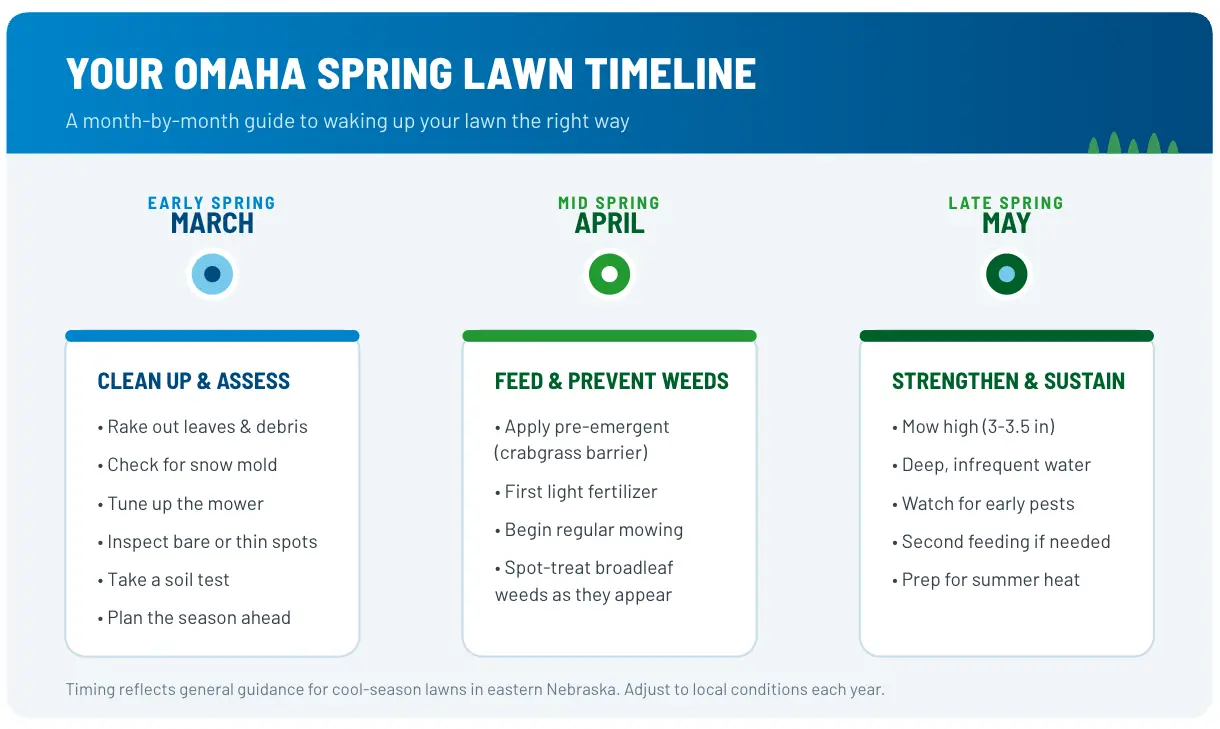
The exact timing shifts a little from year to year, depending on the weather, which is why soil temperature is a more reliable trigger than the calendar alone for certain tasks like pre-emergent application.
What Are the First Steps to Wake Up Your Lawn in Spring?
The first steps are about cleaning up winter debris and assessing the condition of your lawn before you apply anything. Rushing to fertilize or treat a lawn before you have cleared it and understood its needs wastes product and can do more harm than good.
Should You Rake and Clean Up First?
Yes. A light spring raking removes leaves, dead grass, and debris that accumulated over winter, which improves air circulation and lets sunlight reach the soil. Raking also helps identify areas of matted grass or snow mold, a gray or pink fungal patch that can develop under snow cover. Be gentle, since the soil is often soft and the grass is fragile as it comes out of dormancy. Heavy raking on wet soil can tear up healthy grass and compact the ground.
Do You Need a Soil Test?
A soil test is one of the smartest and most overlooked spring investments. It tells you exactly what your soil needs in terms of nutrients and pH, so you are not guessing or applying products your lawn does not actually require. Knowing your soil's phosphorus, potassium, and pH levels lets you fertilize precisely rather than wastefully, which saves money and reduces unnecessary runoff. A soil test every few years is generally enough for most lawns.
How Do You Stop Weeds Before They Start?
The most effective way to stop spring and summer weeds is with a properly timed pre-emergent herbicide. A pre-emergent works by creating a barrier in the soil that stops weed seeds from successfully germinating, which means it must be applied before the weeds sprout, not after. For Omaha lawns, crabgrass is the primary target, and getting the timing right is everything.
What Is Pre-emergent Weed Control?
Pre-emergent weed control is a treatment applied to the soil that prevents weed seeds, particularly crabgrass and other warm-season annual weeds, from establishing. It does not kill existing weeds, which is why timing is so important. Once crabgrass has germinated and is visible, the pre-emergent window has already passed, and a different approach is needed. A well-timed pre-emergent is the single most effective step for keeping a lawn weed-free through the summer.
When Should You Apply Pre-emergent in Omaha?
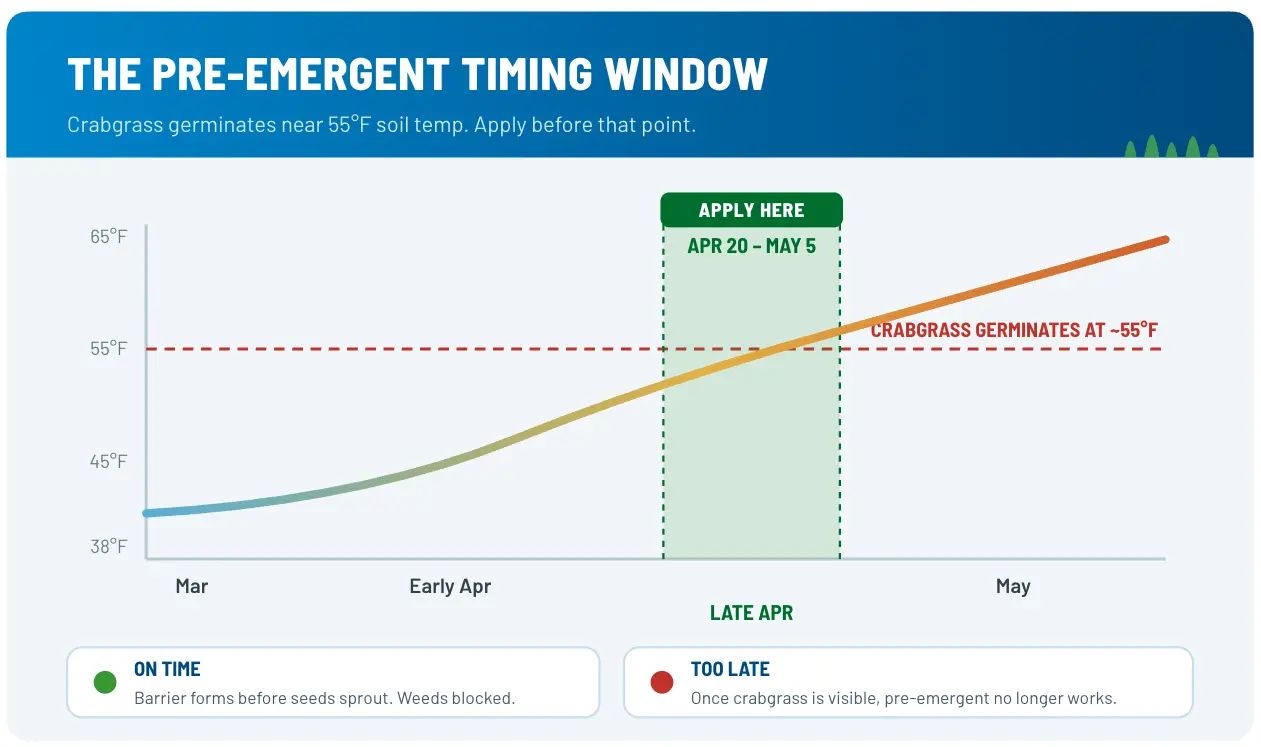
Timing is driven by soil temperature, not the calendar. Crabgrass begins to germinate once soil temperatures reach about 55°F, so the pre-emergent needs to be down before that point. According to Nebraska Extension, the targeted window for crabgrass pre-emergent in eastern Nebraska is roughly April 20 to May 5. The graphic below shows how that window lines up with rising soil temperatures.
When and How Should You Fertilize Your Lawn in the Spring?
Spring fertilization should be moderate and properly timed, not aggressive. A light application of slow-release nitrogen as the lawn greens up provides steady nourishment and supports root development without forcing excessive top growth. According to the UNL Extension Cool Season Lawn Calendar, spring feeding for cool-season grasses works best alongside the late April to early May timeframe, often combined with pre-emergent in a single application. Over-fertilizing in spring is a common mistake that pushes lush, tender growth, which then struggles when summer heat arrives.
Should You Aerate and Overseed in the Spring?
Aeration and overseeding are primarily fall services, but spring can be the right time in specific situations. If your lawn suffered significant compaction or thinning over the winter, spring aeration can relieve that compaction and let water and nutrients reach the roots. Spring overseeding can help fill in bare patches, though it comes with a trade-off: the same pre-emergent that stops crabgrass will also stop new grass seed from germinating, so you generally cannot do both at once. For most Omaha lawns, fall remains the ideal window, but a professional assessment can determine whether spring aeration or overseeding makes sense for your specific situation.
How Should You Mow Your Lawn in Early Spring?
Early spring mowing should begin once the grass is actively growing again, with a focus on a clean, properly timed first cut. The first mowing of the season clears away any remaining dead growth and encourages the lawn to thicken. A few guidelines for spring mowing:
- Make sure your mower blade is sharp before the first cut, since a clean cut heals faster and resists disease
- Never remove more than one-third of the grass blade in a single mowing
- Wait until the soil is firm enough to walk on without leaving deep footprints, to avoid compaction
- Gradually work toward a summer mowing height of around three to three and a half inches as the season progresses
How Can Heartland Lawns Help You Get Your Lawn Ready This Spring?
Here at Heartland Lawns, we have been helping Omaha homeowners get their lawns off to a strong spring start since 1990. Our 6-step lawn care program begins with a comprehensive lawn inspection to assess your property's specific needs, followed by properly timed pre-emergent weed control, balanced fertilization, and treatments tailored to our local climate and soils. We are proud to carry BBB accreditation and were named the Best of Omaha 2025 first-place winner in lawn care, and everything we do is grounded in the values we call HEART: hard work, excellence, action, respect, and trust. When you work with our trained technicians, you get a spring plan built around your lawn rather than a generic schedule.