
Why Is My Lawn Turning Brown? A Nebraska Homeowner's Guide
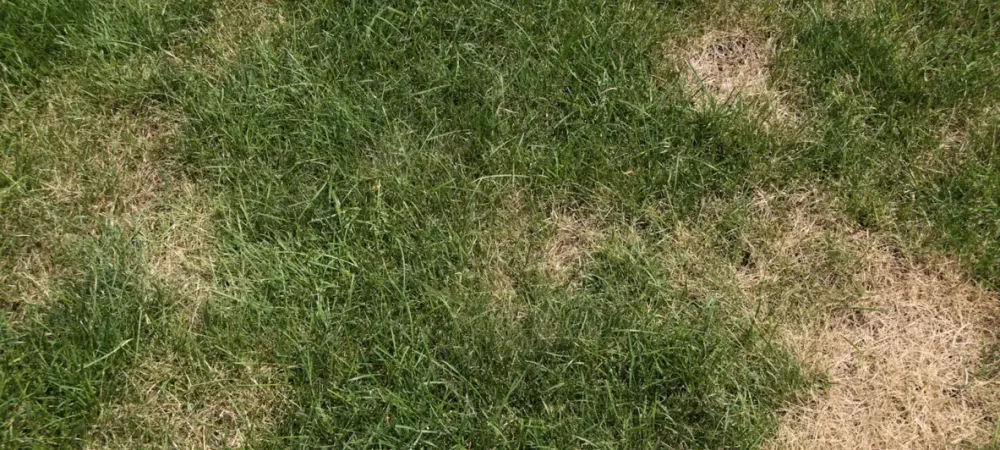
A browning lawn is one of the most confusing problems homeowners face, because so many different issues produce the same brown result. Drought, grubs, disease, pets, and mowing mistakes can all turn a green lawn brown, and the right fix depends entirely on the cause. Treat the wrong problem, and you waste time and money, sometimes making it worse. This guide covers the most common reasons Nebraska lawns turn brown and how to tell them apart.
Is My Brown Lawn Dead or Just Dormant?
Before you do anything, find out whether your brown grass is dead or just dormant, because the two look identical but need opposite responses. Cool-season grasses like tall fescue and Kentucky bluegrass naturally go dormant in summer heat, turning brown to conserve energy while staying alive at the crown. Dormant grass greens back up when cooler, wetter weather returns. Dead grass does not.
The quickest check is the tug test: grab a handful of brown grass and pull gently. If it holds firm, the crown is alive, and the lawn is dormant. If it pulls out easily, that area may be dead and need repair.
What Are the Most Common Causes of a Brown Lawn in Nebraska?
Most brown lawns trace back to one of a handful of causes, and each leaves behind its own tell-tale clues. The key is to look closely at the pattern, the texture, and how the lawn responds to watering. Here are the usual suspects.
Could It Be Drought or Heat Dormancy?
Drought and heat stress are the most common causes of summer browning, and they produce a gradual, fairly uniform browning that shows up first in the hottest, sunniest, and highest spots in the yard. Drought-stressed grass usually turns a dull bluish-gray before it browns, and footprints stay visible long after you walk across it because the blades lack the moisture to spring back. According to Nebraska Extension, checking your irrigation coverage is a good first step when browning appears, since uneven watering often shows up as patchy stress. A few signs that point to drought:
- Browning that starts in sunny, exposed, or sloped areas
- A dull blue-gray cast before the grass goes fully brown
- Footprints that linger instead of bouncing back
- Grass that feels dry and crispy but stays anchored in the soil
Could It Be Grubs?
Grubs are a frequent and often misdiagnosed cause of brown patches, especially in late summer and early fall. These white, C-shaped beetle larvae feed on grass roots underground, cutting the turf off from its water supply. The giveaway is that grub-damaged areas do not green up, no matter how much you water, and the turf peels up like loose carpet because the roots are gone. You may also see skunks, raccoons, or birds digging to feed on them. To confirm, cut a one-foot square of turf and peel it back. Ten or more grubs in that square generally signal a problem worth treating.
Could It Be a Lawn Disease?
Fungal disease is a common cause of browning, and it tends to create distinct patterns rather than uniform fade. Brown patch is one of the most common turf diseases in eastern Nebraska, and according to Nebraska Extension, it produces circular or semi-circular patches of dead-looking blades, sometimes with a darker smoke-colored ring visible around the edge in early morning dew. Because brown patch kills the leaf blades but not the crown, the lawn usually recovers once the disease becomes inactive. Disease is most common on lawns that are heavily watered in the evening, poorly drained, or carrying excess thatch.
Could It Be Pet Urine?
Pet urine produces a very recognizable pattern that is easy to distinguish from other causes. Dog urine is high in nitrogen, so it creates small, roughly circular brown spots, often with a ring of lush, darker green grass around the outer edge where the diluted nitrogen acts like fertilizer. These spots show up wherever a pet frequents the yard and tend to appear and reappear in the same areas.
Could It Be Fertilizer Burn or a Mowing Mistake?
Fertilizer burn and mowing errors are self-inflicted causes that are easy to overlook. Over-applying fertilizer, or spilling it, scorches the grass and often leaves brown streaks or patches that match the path of your spreader. Mowing too short scalps the lawn and exposes the lower stems, which brown quickly, while a dull mower blade shreds the grass and leaves a brownish, frayed cast across the whole lawn a day or two after cutting. Common signs of these issues:
- Brown streaks or stripes matching your spreader or mower path
- A frayed, grayish-brown tint across the lawn after mowing
- Scalped high spots where the mower cut too low
How Can You Tell These Causes Apart?
You can usually narrow down the cause by checking three things: the pattern, the texture, and the response to water. Each cause leaves a different combination of these clues, so running through them in order points you toward the answer. Work through these questions:
- What is the pattern? Uniform fade points to drought, circular patches suggest disease, irregular spreading patches suggest grubs, and small spots with green rings indicate pet urine.
- Does it respond to water? Drought-stressed grass perks up with deep watering, while grub and disease damage does not.
- Does the turf lift up? If the brown area peels back like carpet with no root resistance, grubs are the likely cause.
- Does the pattern match your equipment? Streaks that follow your mower or spreader point to a mowing or fertilizer issue.
Running this quick check before you treat anything saves you from applying a grub product to a drought problem or watering a fungal disease that thrives on moisture.
What Should You Do About a Brown Lawn?
What you do depends on the cause, but the path is the same: confirm the problem, treat it directly, then support recovery with good habits. Dormant or drought-stressed grass comes back with deep, infrequent watering as conditions cool. Grubs and disease need the right treatment at the right time, since timing matters for both. In every case, the best long-term defense is a thick, healthy lawn, which resists stress, pests, and disease far better than a thin one.
How Do You Help a Drought-Stressed Lawn Recover?
A drought-stressed lawn recovers with consistent deep watering and patience. Water deeply two to three times per week to encourage roots to grow downward, rather than light daily sprinkles that keep roots shallow, and avoid heavy fertilizing or aggressive mowing while the lawn is stressed. As temperatures cool in fall, dormant grass naturally greens back up, and fall is also the ideal time to overseed any areas that did not recover.
When Should You Call a Professional?
Calling a professional makes sense when you cannot identify the cause, when the problem is spreading, or when a treatment requires precise timing and product selection. Grub control and fungal disease in particular are easy to misdiagnose and easy to mistreat, and a trained technician can confirm the cause quickly and apply the correct solution before the damage spreads further.
How Can Heartland Lawns Help With a Browning Lawn?
Here at Heartland Lawns, we have been diagnosing and treating browning Nebraska lawns since 1990, and getting the diagnosis right is exactly where we save our customers the most time and money. Our trained technicians can tell the difference between drought, grubs, disease, and the other causes of browning, then apply the right treatment at the right time rather than guessing. We handle grub and pest control, disease treatment, and the fertilization and care that build a lawn dense enough to resist these problems in the first place. We are proud to carry BBB accreditation and were named the Best of Omaha 2025 first-place winner in lawn care, and everything we do is grounded in the values we call HEART: hard work, excellence, action, respect, and trust.
Contact us today for a free estimate and let our team figure out exactly why your lawn is browning and how to fix it.
Frequently Asked Questions
Can I just reseed over a brown lawn?
Not until you know the cause. If you reseed over an active grub or disease problem, the new grass will likely suffer the same fate. Identify and address the underlying issue first, then overseed in early fall, which is the best time for cool-season grass to establish in Nebraska.
How can I prevent my lawn from turning brown next year?
The best prevention is building a thick, healthy lawn through proper mowing height, deep and infrequent watering, balanced fertilization, and fall aeration and overseeding. A dense, well-rooted lawn handles heat, resists pests and disease, and recovers from stress far better than a thin one.
How do I know if my brown grass will come back?
Use the tug test. Grab a handful of brown grass and pull gently. If it stays anchored, the crown is alive and the grass is dormant, so it should recover with water and cooler weather. If it lifts out easily with no resistance, that section may be dead and need overseeding or repair.
Is a brown lawn in summer normal in Nebraska?
To a degree, yes. Cool-season grasses naturally go dormant and turn brown during periods of summer heat and drought as a survival mechanism, and they typically green back up when cooler, wetter weather returns in fall. Uniform summer browning is often dormancy rather than a sign of a dead lawn.
Why is my lawn brown even though I water it every day?
Frequent light watering is often part of the problem rather than the solution. Daily sprinkling keeps roots shallow and can encourage disease, and it does nothing for grub or disease damage. Cool-season lawns do better with deep watering two to three times per week. If watering makes no difference at all, the cause is likely grubs or disease rather than drought.
Why is my lawn brown in patches but green everywhere else?
Patchy browning usually points to grubs, disease, or pet urine rather than drought, which tends to brown more uniformly. Circular patches suggest disease, irregular patches that peel up suggest grubs, and small spots ringed with greener grass suggest pet urine.